
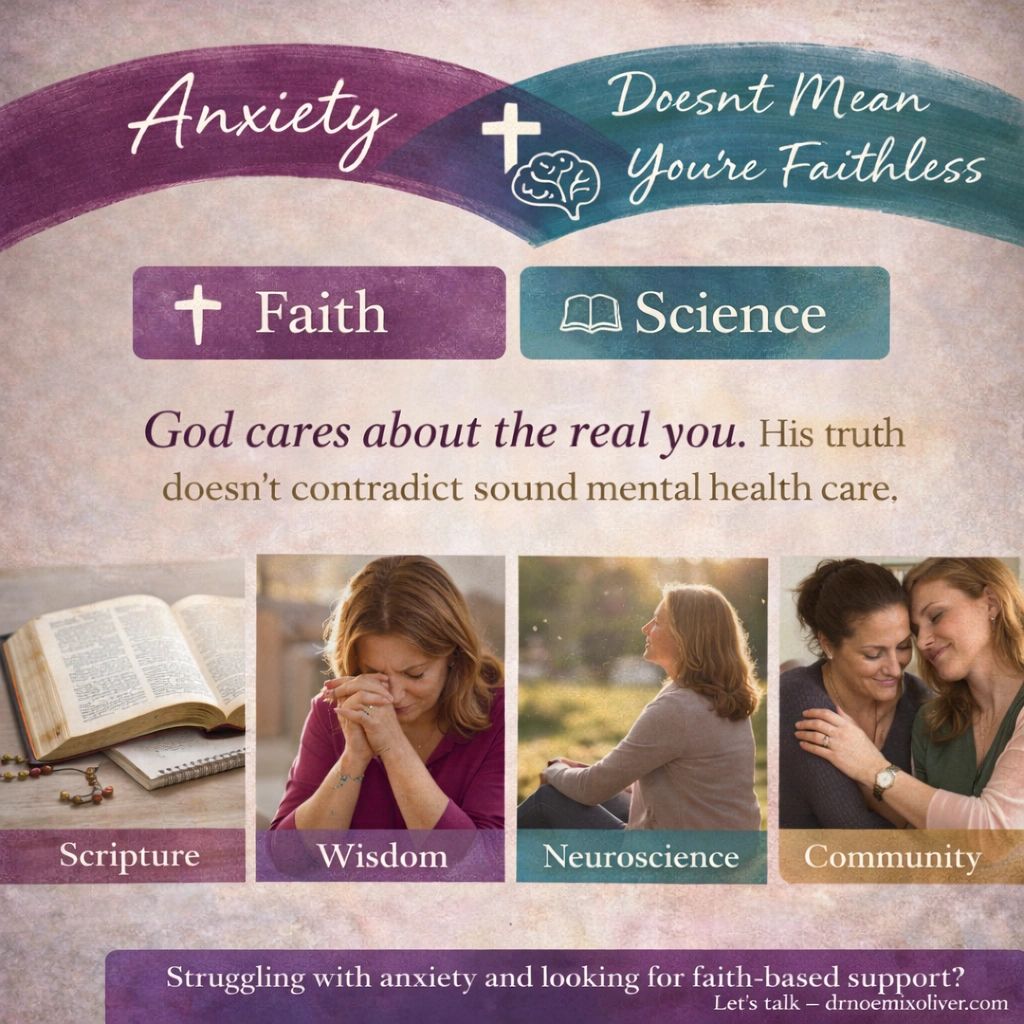
Can I be honest with you about something I've heard far too often?
A woman walks into a church struggling with anxiety. She's lying awake at night, heart pounding, mind spinning. She finally musters the courage to say something — and she's met with: "You just need more faith. If you were really trusting God, you wouldn't feel this way."
She walks out more ashamed than when she walked in. Because now she has anxiety and a faith problem.
Friend, I need to tell you: that is not what the Bible says. And it is not what the science says either.
What the Bible Actually Says About Anxiety
Let's start where the conversation usually starts: Philippians 4:6–7.
"Do not be anxious about anything, but in every situation, by prayer and petition, with thanksgiving, present your requests to God. And the peace of God, which transcends all understanding, will guard your hearts and your minds in Christ Jesus."
Here's what we often miss: Paul is writing this from prison. Not from a comfortable chair with a trouble-free life. He is pointing to a practice, not a performance. Prayer, petition, thanksgiving — these are tools we use in anxiety, not things we accomplish so anxiety never touches us.
Then there's Psalm 34:18: "The Lord is close to the brokenhearted and saves those who are crushed in spirit." Close. Not distant. Not disappointed. Close. And Matthew 11:28–30: "Come to me, all you who are weary and burdened, and I will give you rest." He didn't say come when you've got it together. Come as you are.
The Bible is full of anxious people. Moses. Elijah. Hannah. David. These were not people of weak faith. They were people who brought their full, unfiltered humanity before God — and found Him faithful.
What Psychology Confirms
The anxiety response is not a character flaw. It is a neurological function. Your brain has a region called the amygdala — the "alarm system" — that constantly scans for threats. When it detects danger, it sends stress hormones through your body: cortisol, adrenaline, norepinephrine. Heart rate increases. Breathing shallows. This is the fight-or-flight response — and it is not a sign of weak faith.
Research found that women whose sense of worth was contingent on external validation experienced significantly elevated stress hormones and lower life satisfaction. Anxiety and performance-based identity are deeply connected. When your worth feels conditional, everything becomes a potential threat.
Why "Just Trust God" Often Makes Things Worse
I say this gently but directly: spiritual bypassing — using spiritual language to skip over emotional and psychological realities — does not produce healing. It produces shame.
The brain's stress response doesn't calm down because you quoted a scripture at it. It calms down when the nervous system is regulated, when safety is established, when truth penetrates from the inside out.
Romans 12:2 honors this reality: "Do not conform to the pattern of this world, but be transformed by the renewing of your mind." Not the performing of your behavior. The renewing of your mind. This is an inside-out process that requires both truth and time.
4 Practices Grounded in Both Faith and Science
1. Scriptural Meditation (Not Just Reading). Sit with a single verse — "I am fearfully and wonderfully made" — for five minutes. Breathe it in. Let it settle. Done consistently, this literally reshapes neural pathways.
2. Prayer That Names the Fear. Don't sanitize your prayers. Tell God exactly what you're afraid of. The Psalms model raw, unedited honesty before God, followed by a return to trust.
3. The Present Moment Practice. Anxiety lives in the future or the past. When it rises, ground yourself in the present. Name five things you can see. Breathe slowly. Say: "I am here, right now, and right now I am safe."
4. Community as Medicine. Social connection is one of the most powerful antidotes to anxiety. God wired us for relationship, and isolation feeds anxiety. Find your people — those who can sit with you without shaming you.
You Are Not a Failure for Being Anxious
Anxiety does not mean you are faithless. It means you are human. And God — the God who said "Come to me, all who are weary" — has not disqualified you from His presence because your nervous system is struggling.
If your anxiety is significant and persistent, please consider reaching out to a mental health professional. Coaching, therapy, and in some cases medication can all be appropriate tools — not signs of weak faith, but signs that you are taking seriously the body and mind God gave you.
You were made to live with both peace and wholeness. And you don't have to choose between your faith and your healing to get there.